Color Trading Game: One Round Explained
A colour round, explained from scratch
A color trading game is a betting round dressed up in bright colours. You stake money on which colour, number or size comes up, a countdown runs, and the app announces a result. If your pick matches, the app pays a multiple of the stake; if it does not, the stake is gone. That loop repeats over and over, often on timers of about a minute. People who type "what is color trading" into a search bar usually want to know whether it is an investment, a contest of skill or something else. This page answers that in plain terms: the mechanics, the arithmetic and the legal position in India.
We do not run any gaming service, and this guide is independent of the operators behind these rounds. The genre has no single maker. Many unnamed operators run their own versions, which is why every rule below is described as typical: each app sets its own colours, timers and payout labels, and it can change them without notice.
Why the word trading misleads
Nothing is bought or sold. There is no asset, no market price and no counterparty apart from the platform itself. An education blog run by Rupeezy, a SEBI-registered broker, describes colour trading as gambling rather than trading and points out that neither SEBI nor RBI regulates it. The same article says the platform's own algorithm decides each result. Calling a bet a trade borrows the respectability of the stock market, and that borrowed word is the first thing worth discarding.
Two further details from news reports complete the picture. A win pays a multiple of the stake, and the apps reward users for bringing in new players. That second feature, recruiting for a reward, has nothing to do with markets and a lot to do with how the apps grow.
A colour round from timer to payout
Layouts differ, yet most apps present the round in a similar sequence. The steps below show how such apps typically lay it out, not a standard that every platform follows.
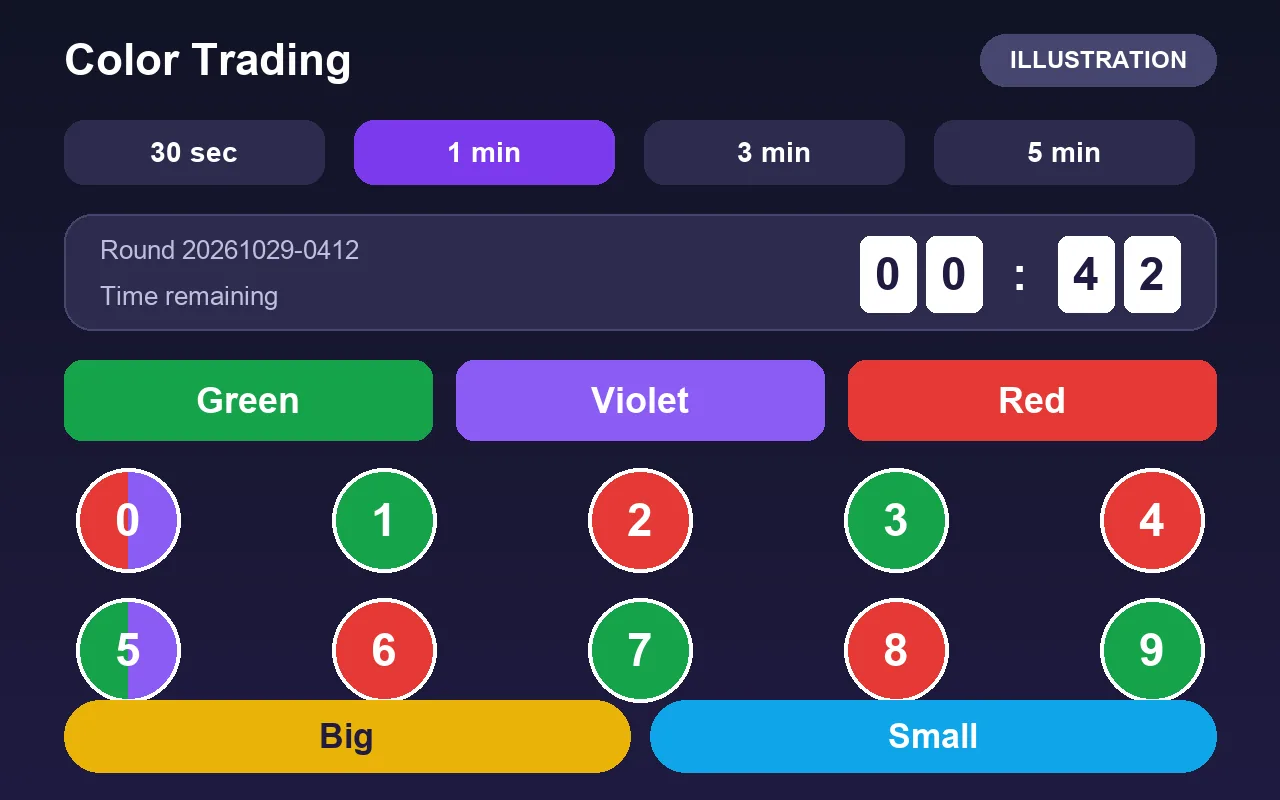
- A timer starts. Rounds commonly last somewhere between 30 and 60 seconds, and some apps offer 1, 3 and 5-minute versions.
- You choose a target: Green, Red or Violet, a single number from 0 to 9, or Big or Small.
- You type a stake and confirm it before the countdown closes the betting window.
- The app reveals one digit, and that digit settles the colour and the size at the same moment.
- Matching picks are credited to the in-app wallet at the stated multiple, and every other stake is lost.
The next round opens almost at once. With a one-minute timer, an hour holds sixty rounds, so a short session can contain far more bets than a person intends to place. The speed is part of the design, and it is the main reason losses grow faster than people expect.
How ten digits carry three colours
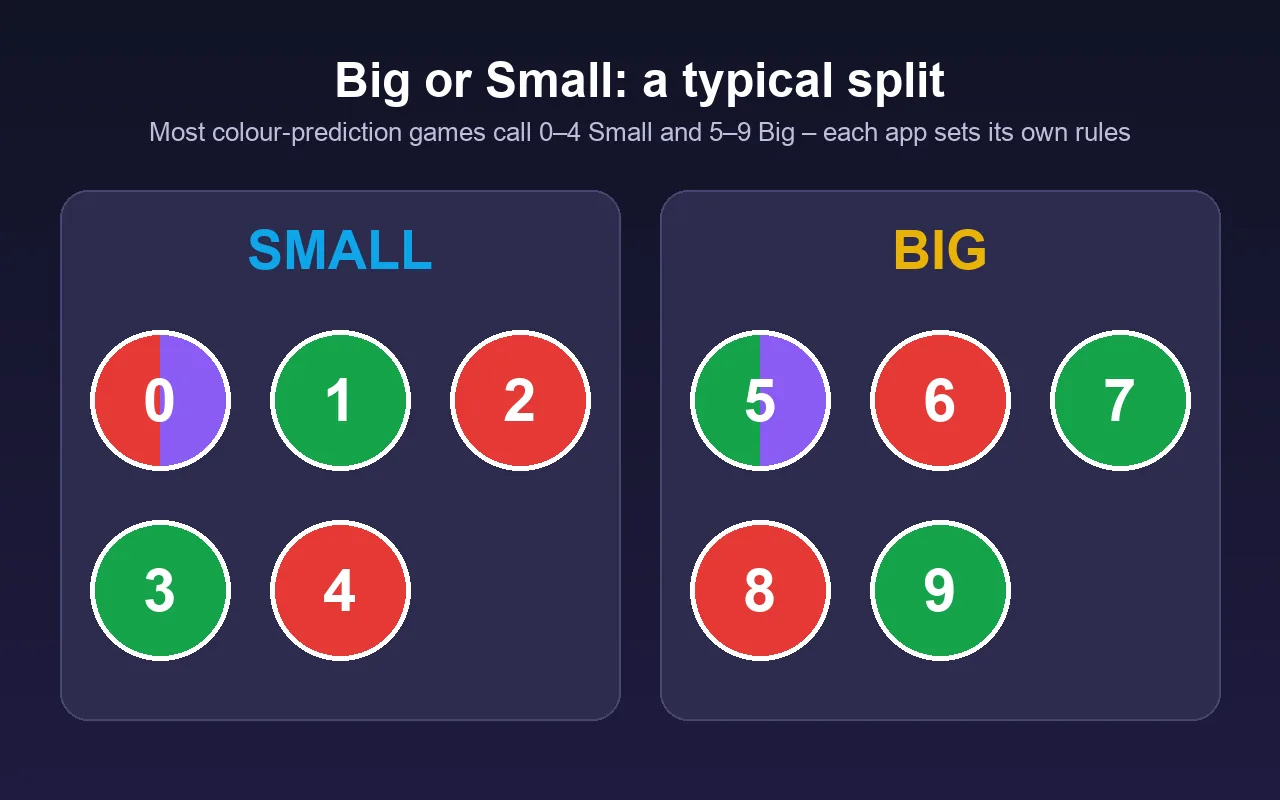
The digit is the real result; colours and sizes are labels hung on it. In the scheme most of these apps show, 1, 3, 7 and 9 are green, 2, 4, 6 and 8 are red, 0 counts as red and violet, and 5 counts as green and violet. Big covers 5 to 9 and Small covers 0 to 4. A single draw of, say, 7 therefore settles every open bet together: green wins, red and violet lose, Big wins, Small loses, and anyone holding the number 7 is paid.
Violet is the odd one out. It sits on only two digits, 0 and 5, which is why apps attach a higher multiple to it than to red or green. Some versions add their own twists to how 0 and 5 settle, so the rules screen of the particular app matters more than any general map, including ours.
Reading the results history
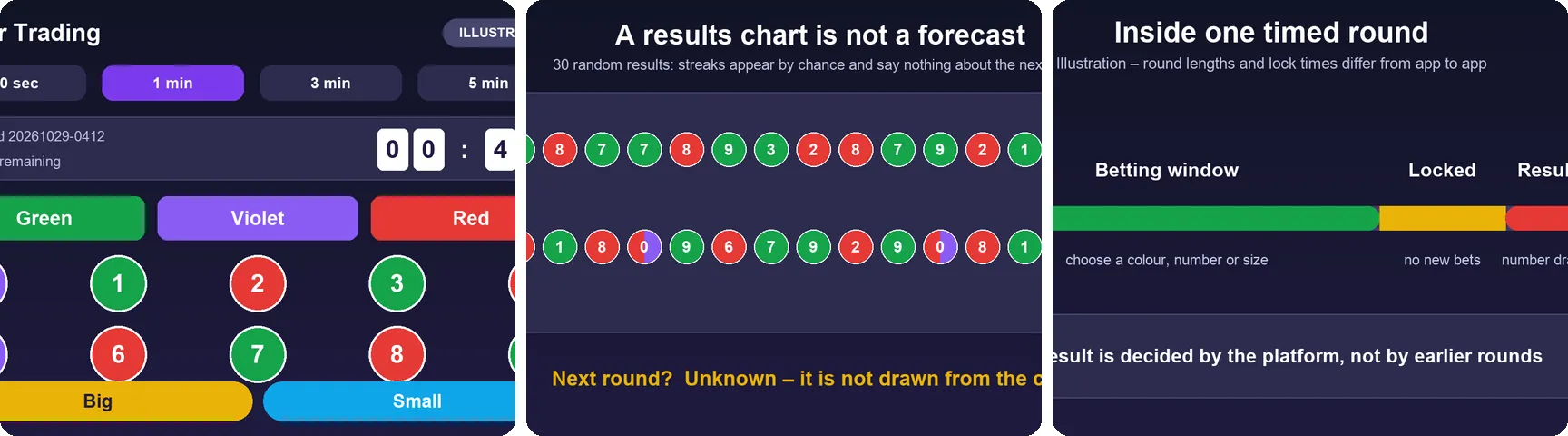
Most apps keep a table of recent rounds showing the round number, the digit, Big or Small, and a coloured dot. Searches for a "color trading chart" usually lead to this history or to screenshots of it shared in groups. It is a record of the past and nothing more. If the platform's algorithm sets each outcome, a run of five reds tells you nothing about round six, and no table can show what the software will choose. A long column of old digits looks like data, yet nothing in it gives a reader an edge.
Doing the arithmetic on the payouts
Promotional pages for these apps typically quote 2x for red or green, 9x for a single number and 4.5x for violet. Those figures come from operator and affiliate sites, so treat them as the way the game is presented, not as a rule. Even taken at face value, they tell a clear story. Suppose, generously, that every digit from 0 to 9 had an equal chance:
- a number bet wins once in ten draws and pays 9x, so ten units staked come back as about nine on average;
- a violet bet wins twice in ten draws and pays 4.5x, which again returns about nine for every ten staked;
- a red or green bet covers five digits and pays 2x, which on paper only breaks even, and only if the draw is fair.
Nobody outside the operator can confirm that the digits are equally likely. The result comes from software the player cannot inspect, run by a company that is often hard to identify. Our editorial score reflects that gap: the round is easy to understand, but its odds cannot be checked, and on most bet types the sums already lean towards the house.
Where the apps come from
If you look for a color trading game online, you will not find the real-money versions in the usual store. The News Minute reported in 2021 that none of them were available on the Google Play Store. A Play search for "colour prediction" that we ran on 29 October 2026 returned only predictor, calculator and analyser utilities, not a betting platform. The money versions move as APK files through websites and referral links. We do not link to any of them, and a file whose source cannot be traced is not one to install.
Where India's law stands
The Promotion and Regulation of Online Gaming Act, 2025 defines an online money game as one where the user pays or stakes money expecting a monetary return, whether the outcome rests on skill, chance or both. Coins or credits that convert to money count as stakes. The Act bans offering such games, advertising them and facilitating their payments, so banks and payment systems may not process that money. The Rules that put it into operation came into force on 1 May 2026. A paid colour round fits the definition on a plain reading, although we found no government notice that names the genre. This is general information, not legal advice.
One last practical note. If you are 18 or older and still decide to open a betting app, fix a limit in time and money before the first round rather than after a loss, and walk away when you reach it. Money staked here is money spent, not money parked. If betting has started to feel hard to control, Tele-MANAS answers on 14416 and on 1-800-891-4416.
What this page asks of you
Personal details: This guide asks for no name, phone number or account. Every section can be read without signing in.
Payments: We take no money and show no deposit form. Any request for UPI, card or wallet details comes from somewhere else.
Device permissions: The page needs no camera, contacts, location or SMS access. It runs in an ordinary browser.
Installs: Nothing here asks you to install an APK. Files passed around in chats cannot be verified, so leave them unopened.
Outbound button: The button at the top leads to an external page. Check what that page asks for before entering any details.


How we score the round itself
What works
- The whole round reduces to one digit, so the rules fit on a single screen
- Colour, number and size bets settle together, which makes results easy to read
- The payout labels, if honest, let anyone check the arithmetic in a minute
What to keep in mind
- Results come from operator software that no player can inspect or audit
- One-minute timers push the number of bets far beyond what people plan
- Payout labels and rules for 0 and 5 vary between apps and can change
Questions about the colour round
Is a colour round decided by skill or by chance?
Neither in the way most players hope. The platform's own algorithm sets the result, according to a SEBI-registered broker's education blog, and the player only chooses which label to back. No amount of practice changes what the software draws. Treat each round as a separate bet whose outcome is fixed by someone else, and judge it on that basis rather than on any feeling of skill that builds up during a session.
Why do some apps pay more for violet than for red?
In the layout most apps use, violet sits on only two digits, 0 and 5, while red and green each cover five. Fewer winning digits means a higher label, typically shown as 4.5x on promotional pages. Even if every digit were equally likely, a violet bet would return about nine units for every ten staked over time. The higher multiple reflects lower chances, not a better deal.
How long does a typical colour round last?
Reports describe rounds of roughly 30 to 60 seconds, and promotional pages show 1, 3 and 5-minute timers. Each app sets its own. The short cycle matters more than it looks: at one round per minute a single hour holds sixty chances to stake money, which is why sessions often end with far more bets placed than intended. Decide on a time limit before the first round.
Can I put money into a colour app in India after May 2026?
The Promotion and Regulation of Online Gaming Act, 2025, with its Rules in force since 1 May 2026, bans offering online money games, advertising them and handling their payments. A paid colour round fits that definition on a plain reading. Banks and payment systems are barred from processing such deposits. We cannot give legal advice, but any platform still taking money is operating against that framework.
Does a colour app count as an investment if it calls itself trading?
No. Nothing is bought, held or sold, and there is no market price. A SEBI-registered broker's blog calls the activity gambling and notes that neither SEBI nor RBI oversees it. The word trading is borrowed to make a bet sound like a financial product. Money placed on a colour is a stake that is either paid at a multiple or lost.
Where do the real-money colour apps come from if not Google Play?
Mostly from websites and referral links that hand out APK files. In 2021 The News Minute found none of them on the Google Play Store, and a Play search on 29 October 2026 showed only predictor and calculator tools. A file passed around in a chat cannot be traced to an accountable company, so we do not link to any and suggest not installing one.